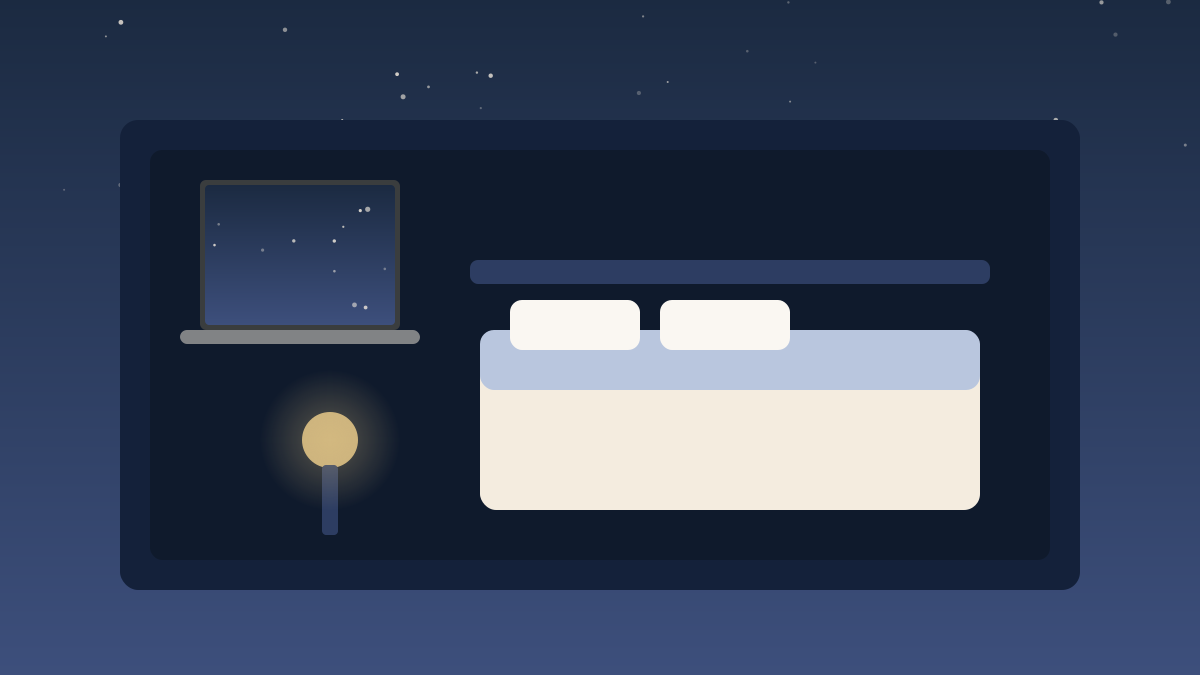
The right bedroom setup for sleep is not complicated: dark enough that you cannot see your hand, quiet enough that sudden sounds do not wake you, cool rather than warm, with fresh air, a bed that supports you, and as little in the room as possible that pulls your attention back to the day.
Very few bedrooms tick all of those boxes, and you do not need to. Fixing the one or two that are furthest off usually makes the difference. This checklist goes through each in the order that tends to matter most, with the cheap fixes first and a pointer to the detailed guide where one exists.
Work through it once, in the evening with the lights as they would be at bedtime. It takes about twenty minutes.
1. Light
Check: Lights off, eyes adjusted. Can you see a glow at the window, a line under the door, or LEDs on chargers and devices?
Why it matters: Light through closed eyelids reaches the part of the brain that runs your body clock. It delays melatonin in the evening and makes sleep lighter in the early hours, which is when street light and a June dawn do the most damage.
Fixes, cheapest first:
- Tape over or switch off standby lights; charge your phone elsewhere.
- Close curtains fully and overlap them in the middle.
- Blackout curtains on a pole that extends past the frame, or a blind behind them.
- If you rent, a no-drill blackout blind that clips to the frame.
- If the light comes from a partner's lamp or a shift pattern, a contoured sleep mask.
The guide to making your bedroom darker covers the audit and the options in detail, and if curtains are on your list, the blackout curtains buying guide explains what to look for.
2. Evening lighting
Check: In the hour before bed, is the ceiling light on? Is the bathroom light bright and cool-white?
Why it matters: Bright, blue-rich light in the evening tells your body clock the day is still going. Dim, warm light from below eye level lets the wind-down happen.
Fixes: Lamps rather than the big light after dinner. Warm bulbs (2,700K or lower) at the bedside. A dim night light for the bathroom. Our guide to bedroom lighting for sleep goes through bulbs and positions.
3. Noise
Check: Lie still for five minutes. What do you hear: traffic, neighbours, plumbing, a clock, a partner?
Why it matters: Your brain wakes to change in sound rather than to volume, so sudden noises in a quiet room are worse than steady noise.
Fixes, cheapest first:
- Move or silence the noises you own: the clock, the rattling valve, the phone.
- Seal gaps around the window and door with draught strip.
- Add soft surfaces: rug, curtains, a bookcase on the shared wall.
- Steady sound from a fan or a sound machine to mask what remains.
- Foam or silicone earplugs for the worst nights.
The full layered approach is in how to block out noise at night.
4. Temperature
Check: Put a cheap thermometer on the bedside table and read it at bedtime for a few nights.
Why it matters: Your core temperature needs to drop for sleep to come easily. Most guidance suggests a cool room of roughly 16–18°C for adults, with the warmth in the bed rather than the air. Comfort varies, but a bedroom at 21°C with the radiator still on is a common and fixable cause of restless nights.
Fixes: Heating timer off an hour before bed. Bedroom radiator valve lower than the rest of the house. Duvet matched to the season rather than one 13.5 tog duvet all year. In summer, blinds closed by day and a window open in the evening. The best temperature for sleep guide explains the range and the seasonal adjustments.
5. Air
Check: Does the room smell stale in the morning? Is there condensation on the window?
Why it matters: A closed bedroom with two people in it gets stuffy overnight. Carbon dioxide builds up, humidity rises and the room feels warmer than it is. There is some research suggesting that better-ventilated bedrooms are associated with better-rated sleep, though the effect is modest.
Fixes: Open the window for ten minutes before bed even in winter, or leave a trickle vent open. If outside noise or pollen makes an open window a bad idea, ventilate well earlier in the evening and use a fan to move air. Keep the door ajar if you can. Damp and mould are worth dealing with separately; they are a health issue in their own right, not just a sleep one.
6. Bed, mattress and pillow
Check: Do you wake with a stiff neck, an aching lower back or a dead arm? Does the mattress sag where you lie? Is the pillow flat?
Why it matters: Discomfort does not always wake you fully, but it causes the small shifts and part-wakings that make sleep feel shallow. Pillows lose their loft within a couple of years; mattresses typically last seven to ten.
Fixes: Match the pillow to how you sleep. Side sleepers need a higher, firmer pillow to keep the neck level with the spine; back sleepers need a lower one; front sleepers need the flattest pillow they can find or none. The pillows for side sleepers guide explains height and fill. A mattress topper can extend the life of a tired mattress for a year or two but will not fix a sagging one. If it is time to replace it, the plain-English mattress buying guide walks through types, firmness and UK trial periods.
Duvet weight and fabric matter here too. Cotton or linen breathes; polyester traps heat. The bedding and duvet tog guide covers seasonal togs and fabrics.
Three checklist fixes that are hard to do for free
Most of this list costs nothing. These are the three items people most often end up buying once they have done the rest.
We may earn a commission if you buy through links on this page, at no extra cost to you. We only recommend product types we would consider ourselves. How we choose products.
Contoured (3D) sleep mask
Example: Manta Sleep Mask
A contoured mask has raised eye cups so the fabric does not press on your eyelids, which many people find more comfortable and which allows the eyes to move freely in REM sleep. Manta's version is marketed with adjustable eye cups and a wide, flat strap designed to reduce light leaks.
- Best for
- Side sleepers and anyone who dislikes pressure on the eyes
- Key feature
- Moulded eye cups that sit around, not on, the eyes
- Why it may help
- The main failure of a cheap flat mask is light leaking in around the nose. A contoured design with an adjustable strap closes that gap for more face shapes.
- Worth knowing
- Bulkier than a flat mask, so less convenient for travel.
No-drill blackout blind
Example: Various (temporary or suction-fit blinds)
Portable or no-drill blackout blinds attach with suction cups or tension fittings and are marketed for rented homes and travel. Some are cut to size.
- Best for
- Renters, travel cots, and windows where curtains leave gaps
- Key feature
- Fits inside the window recess without drilling
- Why it may help
- Fitting inside the recess blocks the edge glow that curtains let through. Combined with curtains, the room can get very dark.
- Worth knowing
- Suction fittings may need re-fixing; less tidy-looking than fitted blinds.
Memory foam pillow for side sleepers
Example: Various UK brands (e.g. Simba Hybrid, Emma, Panda)
Memory foam pillows are marketed for their contouring support and stable height. Several UK brands offer adjustable versions where foam layers or pieces can be removed to change the height.
- Best for
- Side sleepers who need a higher, firmer pillow to keep the neck level
- Key feature
- Supportive foam with enough loft to fill the gap between shoulder and head
- Why it may help
- Side sleepers generally need more height than back sleepers. An adjustable foam pillow lets you fine-tune the loft rather than guessing.
- Worth knowing
- Foam can sleep warm; new pillows sometimes have an initial smell that fades; check the trial and return terms.
7. Clutter, work and screens
Check: Can you see a laptop, a desk, a pile of washing or a to-do list from the bed? Is the TV in the room? Does your phone charge on the bedside table?
Why it matters: The bedroom works best when your brain associates it with sleep and little else. A room that doubles as an office keeps the day in view, and a phone within reach at 3am is an invitation to check it. This is part of what sleep clinicians call stimulus control: keeping the bed for sleep so that lying down becomes a cue for it.
Fixes: If you must work in the bedroom, put the laptop away or cover the desk at night. Move the phone charger to the kitchen, or at least across the room. Tidy the floor and surfaces before bed; it takes five minutes and the room feels calmer for it. Our screens-before-bed guide is honest about how much the phone really matters, and it is linked below.
8. Colour, calm and the things that are just for you
There is no strong evidence that any particular wall colour helps sleep, despite what paint charts say. What does seem to help is a room that feels calm to you: muted colours, soft textures, not too much on the walls, and lighting that can be low. If plants, a particular scent or a specific blanket make the room feel like a place to rest, they are doing a job.
Two small additions that some people find useful: a notepad by the bed for the thought that arrives at midnight, and a pair of bed socks in winter, because warm feet help the body shed core heat. Neither will transform your sleep, but both are cheap.
The checklist in one place
- Dark: LEDs covered, curtains closed and overlapping, blind or mask if needed.
- Evening light: lamps not ceiling lights, warm bulbs, dim bathroom.
- Quiet: gaps sealed, soft surfaces, steady sound, earplugs available.
- Cool: heating off before bed, roughly 16–18°C, duvet matched to season.
- Fresh: window or vent open, no damp.
- Bed: pillow suited to your sleeping position, mattress not sagging, breathable bedding.
For the habits side of the same audit, the Better Sleep Checklist covers routine, caffeine, screens and the rest.
- Calm: work out of sight, phone out of reach, surfaces clear.
Where to go next
Pick the two items you are furthest from and fix those this week; light and temperature are the usual culprits in UK bedrooms. The rest of the Sleep Environment guides go into each one in depth. And if the room is right and sleep still is not coming, the problem is more likely to be habits or a busy mind than the bedroom, in which case a realistic sleep hygiene checklist is the sensible next read.
Sources and further reading
- NHS Every Mind Matters: How to fall asleep faster and sleep better
- NHS: Insomnia
- The Sleep Charity: The Sleep Charity
- Sleep Foundation: Sleep Foundation
This page contains affiliate links. As an Amazon Associate, Quiet Mind Sleep earns from qualifying purchases. Read our affiliate disclosure.
Written and reviewed by the Quiet Mind Sleep editorial team in line with our editorial policy. Spotted an error? Let us know.